
Not sure what to do with your land?
You're closer to clarity than you think.
What We Do
We help landowners answer the questions they've been sitting on.
-
Should I sell?
-
Is now the right time?
-
What happens if I just hold on to it?
We start by listening — your land, your situation, your goals.
Then we walk you through your real options, plainly and honestly. No pressure. No agenda.
Whatever you decide, we'll support it. If selling makes sense, we make it simple. If it doesn't, we'll tell you that too.

What Most Landowners Don't Consider
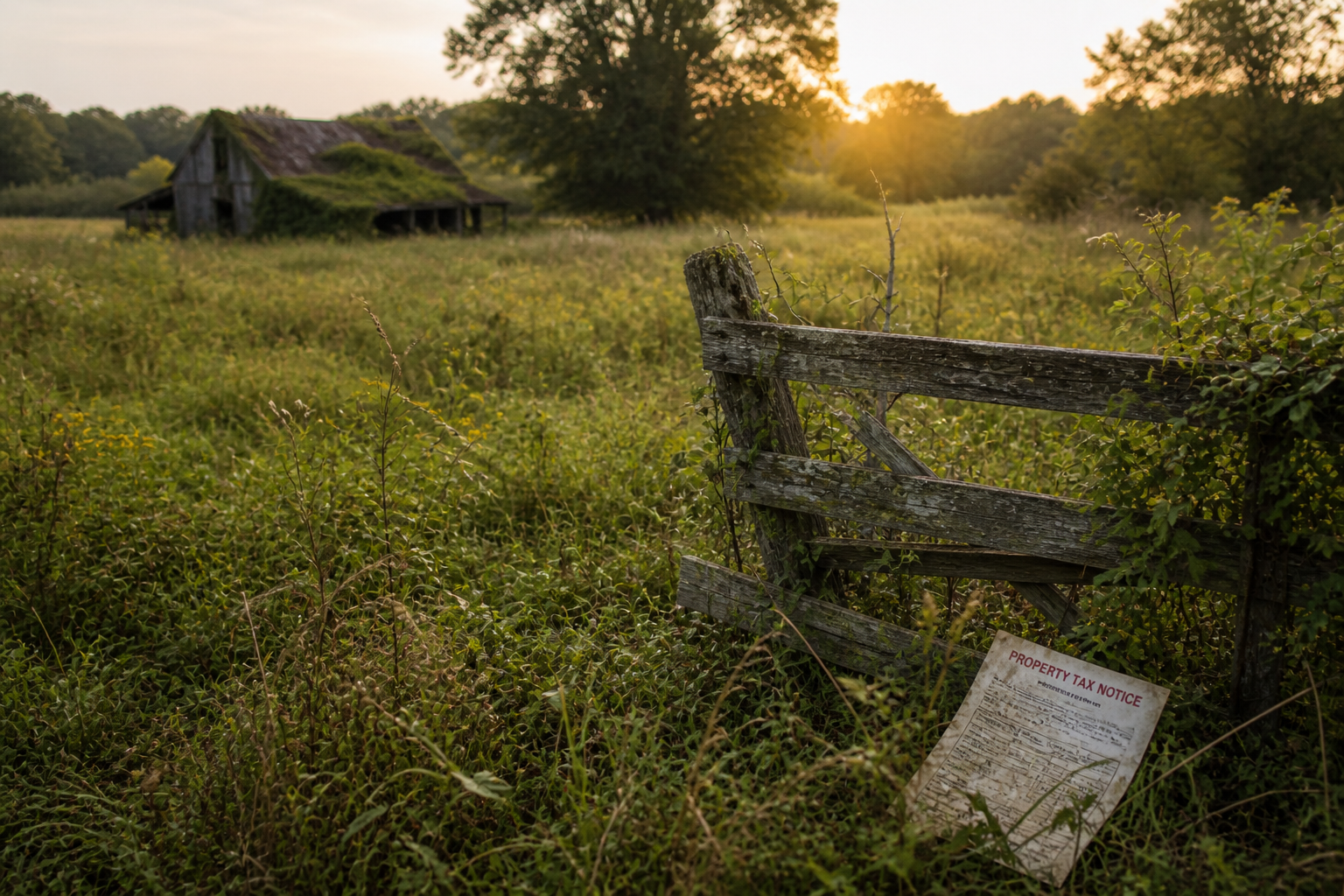
- Holding costs don't pause. Taxes and upkeep keep adding up whether you're ready to act or not.
- Market uncertainty is real. Land values and buyer demand shift. Having a plan puts you in control.
- Ownership only gets more complex. More heirs, more opinions, more names on a deed — and it compounds over time.
- A conversation costs nothing. Waiting might.

About
My path into land started close to home.
A neighbor of mine — an elderly couple I'd known for years — was weeks away from losing their property at auction. When it came up in conversation, I told them I'd see what I could do. What followed was more complex than either of us expected — the property had to go through probate, and the process got messy fast. But we worked through it together.
That experience never left me. I realized how many landowners are carrying similar weight — holding onto land they're unsure what to do with, and never having had someone sit down and actually help them think it through.
I'm not just here to answer questions. I'm here to help you move forward — and handle everything it takes to get there.
Frequently Asked Questions
Can I sell inherited land?
Yes. Inherited land can absolutely be sold, though the process depends on how the property was transferred and whether probate is involved. Many landowners choose to sell inherited property they have no immediate use for rather than carry the ongoing costs of ownership.
Will I owe taxes if I sell inherited land?
Possibly — but far less than most people expect, and in many cases nothing at all. Most landowners don't owe any tax at the time they inherit property. The main tax to understand is capital gains, which only applies when you sell.
When you inherit land in the US, something called a stepped-up basis applies. This means your tax baseline resets to the fair market value of the property at the time of the original owner's death — not what they originally paid for it decades ago. If you sell at or near that value, you may owe little to no capital gains tax.
It's also worth knowing that inheritance tax is a state-level tax, and most US states don't charge it. As of 2025, only five states collect it: Kentucky, Maryland, Nebraska, New Jersey, and Pennsylvania.
Every situation is different and rules vary by state — so consulting a tax professional familiar with your state's laws is always the right move. But for most landowners, the tax burden is far smaller than they feared.
Can I sell my land if there are multiple owners on the deed?
Yes, but all owners typically need to agree to the sale. The more owners involved, the more complex the process can become — especially if family members are spread across different states or have differing opinions. Having the right guidance early makes a significant difference.
What happens if one heir wants to sell but another doesn't?
This is one of the most common situations in inherited land across the US. When multiple people are listed on a deed, all owners typically need to agree to a sale. If one heir wants to sell and another refuses, the process stalls — and the longer it sits unresolved, the more complicated and costly it becomes for everyone involved.
In most US states, a legal process called a partition action allows a court to force a sale when co-owners can't agree. But that path is expensive, time consuming, and often damages family relationships in the process. The best outcomes almost always come from having an open conversation early — before positions harden and legal fees start piling up.
Can I sell land that has back taxes owed on it?
Yes. Owing back property taxes does not prevent a sale in the US. In most cases, any outstanding taxes are simply paid out of the sale proceeds at closing — the title company handles this automatically as part of the transaction. Many landowners assume that back taxes mean they're stuck or disqualified from selling, but that's rarely the case.
If the amount owed is significant relative to the land's value, there may be additional options worth exploring before assuming the worst. The important thing is not to let back taxes be the reason you never find out what's possible.
Do I need a realtor to sell my land?
No. Unlike selling a home, land can be sold directly to a buyer without a realtor. This eliminates commission fees, lengthy listing periods, and the uncertainty of waiting for the right buyer.
What is probate and how does it affect selling land?
Probate is the legal process of settling a deceased person's estate, including any property they owned.
What many landowners don't realize is that every deceased person listed on a deed needs to be individually probated off — and each one comes with its own cost. Depending on the state, probate can run anywhere from a few thousand dollars per name. If two or three relatives have passed and their names are still on the deed, those costs add up quickly — and in cases where there are many names on an ownership, the process can become so costly and complex that some landowners end up walking away from the property altogether.
What surprises many people is that land can still be sold while probate is in progress. A cash buyer can make an offer on inherited land before probate is complete — the sale simply closes once legal authority is granted. This means there's no reason to wait until everything is fully resolved before exploring your options.
If your land has multiple names on the deed — especially names of people who have passed — understanding your options sooner rather than later can save you significant time, money, and stress.
What happens to my land if I don't do anything with it?
Doing nothing is still a decision. Property taxes continue to accrue, maintenance needs don't disappear, and ownership complications can grow over time — particularly as estates change hands across generations.
How do I know you are legit?
We always work with professional title companies and attorneys for our transactions, people who are the best in their field. This way you can feel confident in this relationship.
Is there a cost for your services?
There is no cost for our services. We cover all closing costs and any transaction related fees.
Still have questions? That's exactly why we're here.
There's no script, no pressure, and no obligation. Just a straightforward conversation about your land and what might be possible. Whenever you're ready, we'd love to hear from you.